Project Overview
A manufacturer of UHPC bridge components and precast elements had been experiencing inconsistent compressive strength during continuous production.
Although the existing mix design could achieve high strength under controlled conditions, variations in raw-material quality made it difficult to maintain consistent seven-day and 28-day results across production batches.
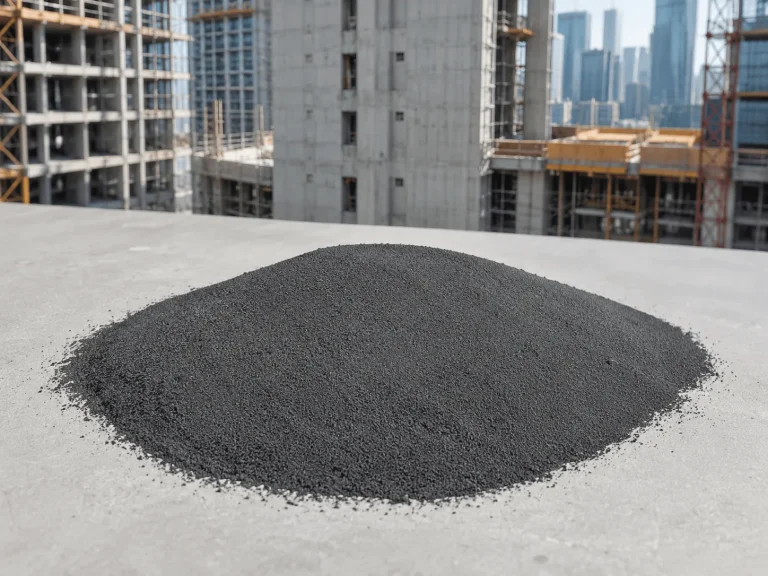
The customer introduced MSILI UH-94 partially densified microsilica and optimized the particle-packing design, material-addition sequence, and mixing process.
The trial produced a more uniform UHPC paste, stable flow-spread results, and more predictable strength development. This gave the manufacturer a more controllable raw-material basis for producing UHPC components at scale.
Production Background
The customer manufactures UHPC bridge components and other high-strength precast elements for engineering projects.
These products require consistent performance in several areas:
- compressive strength;
- workability;
- matrix density;
- dimensional stability;
- batch-to-batch consistency.
The original UHPC formulation already had the potential to achieve high compressive strength. However, during repeated laboratory trials and full-scale production, the customer observed noticeable strength variation between batches.
Even when the producer maintained the same nominal mix proportions, water-to-binder ratio, and curing procedure, some batches developed strength more slowly than expected. Other batches struggled to remain consistently within the target 28-day strength range.
The customer initially investigated several possible causes, including cement quality, quartz-sand grading, superplasticizer compatibility, mixing time, and curing conditions.
The technical review eventually identified microsilica consistency as one of the key variables affecting the stability of the UHPC system.
Why Microsilica Consistency Matters in UHPC
UHPC combines a very low water-to-binder ratio with a high powder content and a densely packed particle structure.
Under these conditions, relatively small variations in microsilica can produce significant changes in:
- water and superplasticizer demand;
- paste viscosity;
- particle dispersion;
- hydration kinetics;
- pore refinement;
- fiber distribution;
- compressive-strength development.
Microsilica therefore acts as more than an ordinary mineral filler.
In a properly designed UHPC formulation, it serves as:
- an ultrafine filler that occupies voids between cement and quartz-powder particles;
- a reactive siliceous material that contributes to additional C–S–H formation;
- part of the particle-packing system that influences rheology, matrix density, and interfacial quality.
When the properties of the microsilica fluctuate between batches, all three functions can become less predictable.
Four Problems Affecting Production Consistency
1. Raw-Material Variation Affected Strength Stability
The customer’s previous microsilica showed variations in properties such as:
- SiO₂ content;
- fineness;
- agglomeration state;
- reactivity;
- dispersion behaviour;
- batch consistency.
Such variations may cause only limited changes in conventional concrete.
In UHPC, however, the low water content and tightly controlled particle-packing system amplify these differences. Changes in microsilica behaviour can alter both paste rheology and hardened performance.
2. Seven-Day and 28-Day Strength Varied Between Batches
Some trial batches showed slower early-age strength development, while others produced less predictable 28-day compressive strength.
The main commercial concern was not whether one specimen could achieve a particularly high value.
The customer needed the production system to meet the specified strength range consistently across multiple batches.
3. Uneven Dispersion Reduced Matrix Uniformity
Stable UHPC strength requires uniform powder dispersion, a refined pore structure, and a dense matrix.
If microsilica agglomerates remain intact during mixing, they cannot fully provide the expected microfilling and pozzolanic effects.
Poor dispersion may also create:
- local weak zones;
- silica-rich agglomerates;
- uneven hydration;
- trapped air;
- inconsistent paste viscosity.
These defects can contribute to strength variation even when the nominal mix proportions remain unchanged.
4. Frequent Mix Adjustments Reduced Production Efficiency
To compensate for raw-material variation, the customer frequently adjusted:
- superplasticizer dosage;
- water content;
- mixing time;
- powder proportions;
- mixing sequence.
These repeated adjustments increased trial-mixing time and technical validation costs.
For a precast manufacturer working to fixed production and delivery schedules, this type of instability can directly affect productivity and project delivery.
Why the Customer Selected MSILI UH-94
The objective was not simply to replace one microsilica with a higher-purity product.
The customer needed a material that could provide a more stable balance of:
- reactive silica content;
- particle filling;
- dispersion;
- handling;
- batch-to-batch consistency.
Stable Performance for UHPC Applications
MSILI UH-94 is positioned as a specialized microsilica grade for high-performance cementitious systems.
Its role in the trial was to provide a more consistent ultrafine siliceous component for particle packing, microfilling, and pozzolanic reaction.
This gave the customer a more controllable basis for maintaining paste density and strength development.
Why a Partially Densified Grade Was Used
The customer also needed a product that could disperse effectively within its existing UHPC production process.
Fully densified microsilica can provide advantages in transport and handling, but strong agglomerates may require greater mixing energy and more carefully controlled dispersion.
Undensified microsilica generally disperses more readily, but its very low bulk density may create challenges in storage, feeding, dust control, and production consistency.
MSILI UH-94 partially densified microsilica was selected to balance:
- dispersion performance;
- handling efficiency;
- batch consistency;
- suitability for high-powder UHPC systems.
The partially densified form was not chosen merely for convenience. It was selected to match the customer’s mixer, production cycle, and dispersion requirements.
Trial Strategy
The project focused on systematic optimization rather than a simple one-for-one raw-material replacement.
The main steps included:
- replacing the previous variable microsilica with MSILI UH-94;
- maintaining the microsilica dosage within a technically reasonable UHPC range;
- optimizing the dry- and wet-mixing sequence;
- improving agglomerate breakdown;
- monitoring flow spread;
- measuring seven-day and 28-day compressive strength;
- tracking variation between trial batches;
- fine-tuning the superplasticizer dosage without repeatedly redesigning the complete formulation.
The objective was to improve repeatability while preserving the required strength and workability.
Reference UHPC Mix Design
The customer used a formulation containing cement, microsilica, quartz powder, quartz sand, water, a polycarboxylate-ether superplasticizer, and steel fibers.
The target compressive strength was at least 120 MPa.
| Raw material | Reference proportion |
|---|---|
| Cement | 1.00 |
| MSILI UH-94 microsilica | 0.25 |
| Quartz powder | 0.35 |
| Quartz sand | 1.10 |
| Water | 0.25 |
| PCE superplasticizer | 0.0012 |
| Steel fibers | 2% by volume |
These proportions are presented as a reference from the customer trial, not as a universal UHPC formulation.
The central design principle was not simply to increase the microsilica content. It was to improve particle packing between cement, microsilica, quartz powder, and quartz sand while maintaining workable paste rheology.
Optimized Mixing Sequence
The customer used the following mixing procedure during the trial.
Step 1: Premix Microsilica and Quartz Sand
The microsilica and quartz sand were dry-mixed at low speed for approximately five minutes.
Collisions and friction between the harder sand particles helped break down some microsilica agglomerates and distribute the fine powder more evenly.
Step 2: Add Cement and Quartz Powder
Cement and quartz powder were then added, followed by a further five minutes of dry mixing.
This step helped distribute the microsilica throughout the complete powder system before water entered the mixer.
Step 3: Add Water and PCE Superplasticizer
Water and the polycarboxylate-ether superplasticizer were introduced gradually.
The mixture moved from a dry, agglomerated state into a cohesive and dispersed paste.
Rather than increasing the superplasticizer dosage immediately, the customer first focused on achieving proper powder wetting and dispersion.
Step 4: Add Steel Fibers
The steel fibers were added only after the paste had formed.
The mixture then underwent approximately two minutes of high-speed mixing to distribute the fibers while limiting clustering.
This sequence focused on two critical objectives:
- breaking down microsilica agglomerates;
- forming a uniform paste before introducing steel fibers.
Trial Results
Flow-Spread Performance
The recorded UHPFRC flow-spread values were:
- 260 mm;
- 260 mm;
- 265 mm.
The three results remained within a narrow five-millimetre range.
Under the customer’s test conditions, the paste retained the cohesive and self-compacting characteristics required for production.
The narrow result range also indicated more controllable fresh-state behaviour during the trial.
Compressive Strength
Under the customer’s stated ambient curing conditions, the measured compressive strengths were:
- 7-day compressive strength: 108.07 MPa
- 28-day compressive strength: 139.21 MPa
The 28-day result exceeded the customer’s target strength of 120 MPa.
More importantly, the customer viewed the trial as a step toward achieving more predictable strength development rather than merely producing the highest possible single result.
Observed Production Improvements
During the customer trial, the UHPC system showed several practical improvements.
More Uniform Paste
The powder system dispersed more evenly, producing a more homogeneous UHPC paste.
More Stable Flow
The flow-spread results remained within a narrow range, making the fresh mixture easier to control during production.
More Predictable Early Strength
Seven-day strength development became more consistent, and fewer trial batches showed unexpectedly low early strength.
Reduced 28-Day Strength Variation
The 28-day results became easier to maintain within the required engineering range.
Fewer Corrective Adjustments
The customer reduced the need to compensate for raw-material fluctuations by repeatedly changing the water content, water-to-binder ratio, superplasticizer dosage, or principal powder proportions.
Scope of Technical Support
The project involved more than supplying MSILI UH-94 microsilica.
The technical recommendations covered:
- relevant microsilica quality indicators;
- initial dosage screening;
- matching with quartz powder and quartz sand;
- dry- and wet-mixing sequence;
- PCE superplasticizer compatibility;
- seven-day and 28-day strength verification;
- monitoring of batch-to-batch consistency.
This approach helped the customer evaluate the microsilica as part of the complete UHPC system rather than as an isolated raw material.
Technical Review
The review indicated that the customer’s original challenge did not result from an inability to produce high-strength UHPC.
The main problem was that variation in a critical raw material made strength development less predictable.
MSILI UH-94 provided a more stable siliceous component and a more controllable dispersion condition within the tested mix.
This reduced one important source of variation in:
- particle packing;
- paste rheology;
- microfilling;
- pozzolanic activity;
- matrix density.
The result was a UHPC production system that became easier to adjust and more likely to achieve the target strength consistently.
What This Case Demonstrates
UHPC strength variation rarely comes from one parameter alone.
It usually reflects the combined effects of:
- raw-material consistency;
- particle grading;
- powder dispersion;
- water and admixture dosage;
- mixing energy;
- fiber distribution;
- curing conditions.
Microsilica plays a central role because it affects several of these factors simultaneously.
This case demonstrates that UHPC manufacturers should not select microsilica solely according to price or a single SiO₂ value.
They should also evaluate:
- particle-size distribution;
- agglomeration state;
- water demand;
- reactivity;
- dispersibility;
- PCE compatibility;
- batch-to-batch consistency;
- performance within the actual UHPC formulation.
Conclusion
By introducing MSILI UH-94 partially densified microsilica and optimizing the mixing process, the customer produced a more uniform UHPC paste, achieved stable flow-spread results, and obtained seven-day and 28-day compressive strengths of 108.07 MPa and 139.21 MPa, respectively, under the stated trial conditions.
The value of the project did not lie only in reaching a high final strength.
It lay in reducing one important source of production variation and helping the customer move from laboratory-level high performance toward more consistent industrial UHPC production.
For manufacturers of UHPC bridge components, cover slabs, RPC products, precast structural elements, and high-strength joint materials, MSILI UH-94 offers a specialized microsilica option designed to balance reactivity, dispersion, particle packing, and production consistency.
The test results in this case apply to the customer’s specific materials, proportions, equipment, mixing procedure, and curing conditions. Producers should conduct project-specific trials before commercial use.